

Decision summary
Confirmed
What changes
- Union OSS does not cover every movement or sale from a European warehouse.
- OSS corrections retain the original period; the time limit starts at the original return's statutory due date.
Recommendation
What you can do
- Map the entity, dispatch country, destination and customer status.
- Separate own-goods transfers, domestic sales and distance sales.
- Reconcile sales, credit notes, returns and payments within their respective reporting routes.
To establish
What remains unknown
- A real business's national obligations and applicable rates still require assessment.
- The example's 20% rate is educational, not a validated national rate.
The VAT One Stop Shop can centralise reporting for certain European B2C sales. It does not cover every movement through a European warehouse. For an ordinary French seller owning its stock, first separate moving its own goods to another country, local sales from that warehouse and sales to consumers in another country. Assign each flow to its reporting route, then reconcile sales, credit notes and returns. Neither the head-office country nor a marketplace payout is enough to classify transactions.
This guide is for business owners, finance, operations and e-commerce teams selling goods to individuals in the European Union. It distinguishes Union OSS, national obligations, IOSS for certain imported goods and the cross-border SME scheme. B2B transactions, chain transactions, special territories and products with specific rules need dedicated assessment. Numerical examples are educational, with no customer data or commercial forecasts.
Initial sources were reviewed on 9 November 2026, with additional checks on 10 November 2026. The European Commission explains OSS operation and scope; the DGFiP describes its use in France. Future ViDA changes are separated from rules applicable on that date. Final tax treatment needs validation against actual transactions by the competent function. This English edition keeps the French-business context of the original.
Contents
- Separate place of taxation, thresholds and reporting
- Map the sale and the physical movement
- Understand the EUR 10,000 threshold
- Foreign stock raises questions beyond OSS
- OSS, IOSS and the marketplace role
- Build a record that reconciles
- Organise closing, corrections and payment
- Calculate complete costs without predicting gains
- Prepare for ViDA without applying future rules early
- Actions and reasons to wait
- Self-assessment
- Closing checklist
- Sources and limits
Separate place of taxation, thresholds and reporting
Three questions follow one another but remain distinct. First, where is the transaction taxable? Second, does a derogation or exemption apply? Third, what reporting route is available for the VAT due? The One Stop Shop chiefly answers the third question. It cannot turn a misclassified transaction into an eligible sale or correct an incorrect rate supplied by the catalogue.
For intra-Community distance sales of goods, the general rule places taxation where transport ends. The Commission describes a derogation below a common €10,000 threshold, subject to cumulative conditions. This is neither a general VAT exemption nor a separate allowance per country. A system assigning independent threshold counters to Spain, Belgium and Germany would therefore be misleading.
OSS is optional. The DGFiP explains registration and notes that, without the scheme, necessary registrations where VAT is due still need addressing. Choosing OSS does not mean selecting whichever sales you wish to report. Once a scheme is chosen, transactions within its scope must be included according to its rules across the countries concerned.
The Member State of identification is not always freely chosen. The Commission describes rules according to establishment and scheme. A business established in France in the ordinary configuration addressed here uses the French portal. Companies with establishments or structures outside the Union must assess their situation. The software’s hosting country does not determine the Member State of identification.
Prepare the Union OSS start date before the first transactions intended for that route. DGFiP describes the general effective date as the first day of the quarter following the application, with arrangements allowing a start during the quarter. It also describes a derogation for certain registrations after transactions begin, completed no later than the tenth day of the month following the first transaction. Check applicability in the real case; this is not a reason routinely to delay registration.
The short B2C distance-sales note, in French explains the threshold. This guide focuses on work OSS leaves to organise: actual dispatch, foreign stock, returns, local reporting and reconciliation. It addresses ordinary B2C goods sold by a French business. Excise goods, new means of transport, complex chains and special territories require dedicated assessment.
| Question | What it determines | Necessary information | What it does not prove |
|---|---|---|---|
| Where is the sale taxable? | Taxation country | Customer, product, transport, applicable rules | Correct reporting route already configured |
| Does a derogation apply? | Possible special treatment | Establishments, thresholds, conditions | General exemption for online trade |
| Does OSS cover the sale? | Reporting through the chosen scheme | Transaction type and registration | No local obligation arising from stock |
| Who collects VAT? | Seller or interface role | Marketplace assessment | All obligations handled by the platform |
Map the sale and the physical movement
Start with transactions, not channel names. A marketplace sale can dispatch from France, a German warehouse or directly from a third country. These do not all receive the same treatment. Record selling entity, customer, actual dispatch location, destination and any platform role. Site country and currency replace none of these fields.
Where several warehouses can fulfil an order, obtain dispatch location from actual fulfilment. Defaulting all sales to France becomes unreliable if logistics reallocates stock. Establish when actual location becomes available and how it corrects the record. Expected but missing information should appear as an exception, never silently as head-office location.
Define destination under the rules for the transaction. For transported goods, where transport ends is central. A French billing address does not prove delivery in France. Gifts, intermediaries or changed addresses can create differences. Specify which fulfilment evidence is retained and how the competent person examines inconsistencies.
Customer status is another boundary. An invoice bearing a company name is not sufficient by itself to apply an intra-Community B2B regime automatically. A business customer may also buy under circumstances needing more assessment. Retain status assessment and evidence, with an exception queue where information is inconclusive. This guide does not prescribe defaulting every ambiguous order to B2C.
Record stock movement separately from the consumer sale. Moving owned goods from a French warehouse to another Member State is not the same operation as selling to an individual. Transfers, acquisitions and national obligations need assessment under local rules. Extracting only paid orders can miss these movements, although they help explain why a foreign VAT number or additional return may be necessary.
A return adds a journey without erasing the first one. Goods can return to a country different from their original dispatch or future resale location. The commercial refund and VAT correction must stay linked to the original sale, while the new physical movement can raise separate questions. Current stock country cannot replace the history of dispatch and arrival for each operation.
Begin with cases covering possible operations: France to a consumer abroad, domestic sale from foreign stock, cross-border sale from that stock and a return. The number depends on fulfilment arrangements; cover branches rather than assembling a large arbitrary sample. An unobserved situation that a logistics contract permits remains a configuration risk to clarify.
Understand the EUR 10,000 threshold
The Commission gives three cumulative conditions for the derogation: the supplier is established, or otherwise has its permanent address or usually resides, in only one Member State; the transactions meet dispatch and destination conditions; and relevant turnover excluding VAT does not exceed €10,000 in either the current or preceding calendar year. Relevant intra-Community distance sales and certain B2C telecommunications, broadcasting and electronic services are added together.
Consider a fictional business meeting the other conditions. During the current year it makes relevant sales excluding VAT of €4,600 to Belgium, €3,200 to Spain and €1,700 to Germany: €9,500 before any relevant services. Another €700 sale brings the total to €10,200. This illustrates crossing the threshold, not a real tax file.
A supplier meeting the threshold conditions can opt for destination taxation, but the Commission says the option binds it for two calendar years. It is not a switch to toggle according to the most favourable rate on each order. Keep the date, basis and consequences so technical staff do not alter a tax configuration merely to resolve price display problems.
Foreign stock needs particular care. A French headquarters does not justify applying below-threshold reasoning to every dispatch. The origin condition matters. Sales starting in another Member State require their own assessment. Separate these flows before calculating or applying the derogation; an accurate counter over the wrong population still produces a wrong decision.
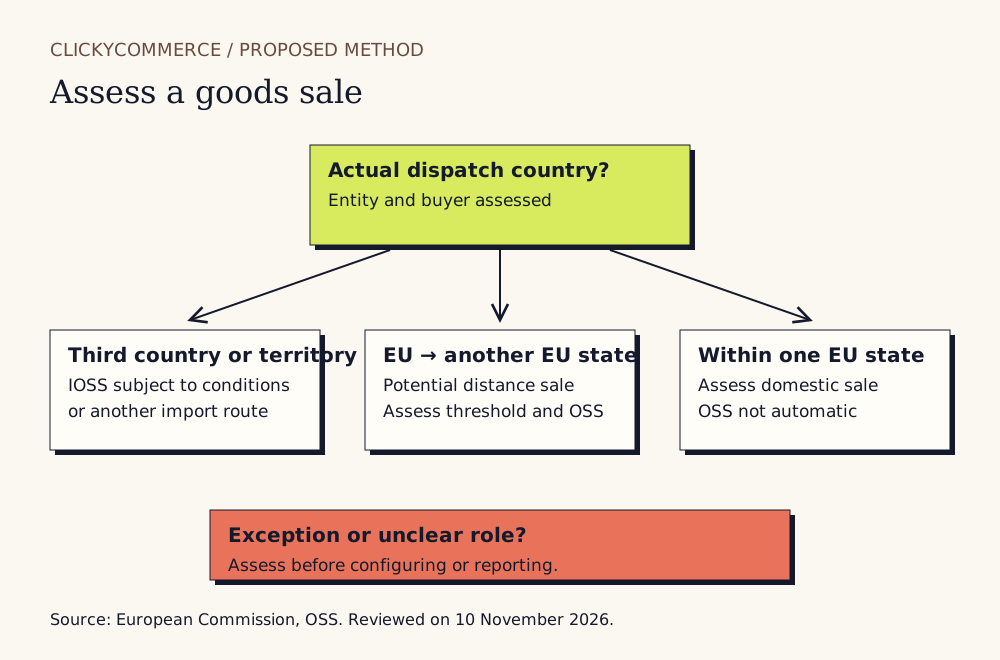
An orientation tree for ordinary B2C goods: special situations return for dedicated assessment.
Three thresholds answering three different questions
The French domestic exemption concerns national exemption under its conditions. The €10,000 threshold concerns the place of certain sales and services. The cross-border SME scheme allows exemption in other countries after required procedures and conditions. Keep three separate decisions. Being below one amount does not settle another transaction. The spreadsheet must explain its basis rather than substituting the smallest amount for every rule.
The official French domestic exemption page, checked on 10 November 2026, gives commercial-activity thresholds of €85,000 for the previous year and an increased in-year limit of €93,500. Exceeding the base threshold without exceeding the higher limit does not cause exit on the same date as exceeding that higher limit. These are neither per-country EU sales exemptions nor OSS tolerances. Mixed activities, business starts and other categories have their own rules.
A fictional shop has €82,000 commercial turnover in 2025 and €90,500 in 2026, never exceeding €93,500 during 2026. Under the official example’s configuration, it can retain the French exemption during 2026 but exceeds the base threshold for the following year. This illustrates the two limits. Foreign sales still require place-of-taxation assessment and, where relevant, actual cross-border SME eligibility. Overall turnover alone does not choose the reporting route.
For the cross-border SME scheme, the €100,000 Union ceiling applies alongside national thresholds and formalities; it does not remove advance notification. Input VAT deduction also needs consideration. Before choosing, compare unrecoverable input VAT, prices, actual target countries and monitoring work. Not charging VAT is an economic advantage only after a complete comparison.
Foreign stock raises questions beyond OSS
Assume a French-established company uses a warehouse in another Member State. Determine who owns the stock and which operations brought it there. Import, local purchase and own-goods transfer differ. Assess obligations in that country before activating logistics. A storage contract does not determine every reporting obligation.
Dispatch from that warehouse to a consumer in another Member State may qualify for Union OSS as an intra-Community distance sale, subject to the applicable conditions. If dispatch and arrival are in the same country, the ordinary seller’s sale is domestic and not automatically covered. The Commission distinguishes this from domestic supplies by an interface treated as deemed supplier.
The return section of the official OSS guide, in French addresses dispatch from a country other than the Member State of identification. It explains entering the dispatch country’s VAT number and mentions exceptional situations without a registration obligation there. This prevents claiming that stock presence always creates identical registration obligations without examining operations.
The practical recommendation remains demanding: assess local obligations before opening a stock country. OSS does not prove that transfers, acquisitions, local sales and input VAT are handled. Logistics can supply movements, but an export is not a filed return. Assign who receives, assesses and verifies evidence of their treatment.
| Goods flow requiring assessment | Possible route as reviewed on 9 November 2026 | Separate check |
|---|---|---|
| France to an individual in another EU country | Union OSS if eligible and chosen | Threshold, rate, registration, destination |
| Stock in one other country to a consumer in a third | Union OSS potentially available | Actual dispatch and local stock obligations |
| Foreign stock to a consumer in the same country | National return for the ordinary seller | Do not automatically extend OSS |
| Own-goods movement between countries | Assessment of transactions and related returns | Do not classify as a B2C order |
| Third country to EU consumer | IOSS under conditions, or another import route | Consignment value, product, role, customs |
France to Germany: an own-goods transfer before any sale
The educational case follows fictional Atelier Exemple, established in France, owning the goods, liable to VAT under the assumptions and registered for Union OSS with an already confirmed effective date. It sends twenty units from France to its German stock, without a sale or ownership change. Specific derogations are excluded after assessing this scenario. Article 17 of the VAT Directive generally treats this transfer of business goods as a supply; Article 21 addresses the acquisition at destination. It is not a B2C order to report as such in OSS.
BOFiP, BOI-TVA-DECLA-20-20-40, paragraph 95 describes the French recapitulative statement for an assimilated transfer: the customer’s number is replaced by the taxable person’s own VAT number in the arrival country, and value follows the applicable rule where there is no selling price. Organise the French side and German acquisition treatment before starting. OSS does not complete them for the business. National returns, VAT identification and transport evidence remain separate objects.
The VAT recapitulative statement and EMEBI survey, explained in French are separate formalities, fiscal and statistical respectively. Determine separately whether the business is surveyed and what statistical obligations it has been notified of. Likewise, call-off stock arrangements do not apply merely because goods are held by a logistics provider. Their conditions, including those relating to the intended acquirer, need assessment. Seller-owned stock serving future consumers does not by itself establish those conditions.
Three sales from two dispatch locations
V-101 dispatches from France to a Belgian individual: under the example assumptions, an intra-Community distance sale reported through Union OSS with Belgium as consumption country. V-102 dispatches from German stock to a German individual: a domestic sale for this ordinary seller, handled through the applicable national route outside its OSS return. V-103 dispatches from Germany to a French individual: foreign dispatch does not prevent Union OSS for this distance sale under the scheme’s conditions.
The third customer’s return retains V-103 as origin. If the unit returns to France, the credit note corrects the sale linked to France as consumption country; the physical return is recorded separately. A later dispatch from France is a new operation to assess. Replacing V-103’s original dispatch with today’s stock location would destroy history and could assign the wrong reporting route. Exports therefore distinguish dates and countries for sale, return and recirculation.
| Fictional operation | Dispatch → arrival | Classification in this case | Evidence to obtain |
|---|---|---|---|
| TR-001, twenty owned units | France → Germany | Own-goods transfer, outside B2C OSS; origin and destination routes | Transport, receipt and national assessment |
| V-101, B2C sale | France → Belgium | Union OSS, consumption Belgium | Fulfilment, validated base and rate, return record |
| V-102, B2C sale | Germany → Germany | Ordinary seller’s domestic sale, outside its OSS | Applicable national treatment and return |
| V-103, B2C sale | Germany → France | Union OSS, consumption France | German dispatch reconciled with sale |
| AV-103, later credit note | Return to France | Correction linked to V-103; movement tracked separately | Credit note, refund and original period |
This matrix gives an OSS/German-stock project facts to discuss. It does not approve activating a real warehouse. Activity, derogations, seller VAT position and German obligations must match the assumptions. For another country or entity, retain the branches but repeat assessment. The case prepares the work without claiming the same number or form suffices everywhere.
OSS, IOSS and the marketplace role
IOSS concerns certain distance sales of goods imported from third countries or territories in consignments whose intrinsic value does not exceed €150, with exclusions including excise goods. The Commission states that goods already in an EU warehouse are not distance sales of imported goods for this purpose. Manufacturing origin alone does not place them within IOSS.
The €150 IOSS threshold and €10,000 intra-Community threshold concern different things. One is a consignment’s intrinsic value in an import scheme; the other is an annual aggregate and place-of-taxation derogation. Combining them in one Europe threshold rule invites errors. Keep the mechanism’s name and decision basis in the record.
A marketplace adds deemed-supplier assessment in certain situations, not general handling of all sellers’ VAT. The Commission describes facilitated sales of goods already in the Union by an underlying supplier established outside it, and certain low-value imports. Identify the platform’s actual role for each transaction, read applicable documentation and reconcile amounts. A tax line in a report does not settle every obligation.
A French company can use a platform without that platform being deemed supplier for all its sales. Separate interface-collected taxes from sales for which the seller remains liable. The opposite risk is duplicate reporting, importing the same amounts from order and platform reports. Stable transaction identifiers and documented tax status prevent deciding between omission and duplication solely from the net payout.
Special territories are another boundary. A country name in an address does not always establish inclusion in the EU VAT territory. Some territories require specific treatment. Prepare assessed exceptions with tax advisers and test destination handling in the shop. Generic France or Europe shipping zones can hide mismatches between logistics and tax territories.
Build a record that reconciles
Keep enough information to reconstruct the decision without copying the entire customer file. Connect transaction identifier, relevant date, entity, channel, customer status, product, dispatch country, consumption country, scheme, taxable base, rate and VAT. Identifying documents remain in suitable systems with appropriate access. The annex model contains only fictional examples.
Retain each field’s provenance. Dispatch country may come from logistics; price and discounts from orders; platform role from documented assessment; rate from a reference validated for the product and date. Without provenance, teams can repair the wrong source. A manual correction in the reporting file can hide a fault recurring at the next export.
Taxable base differs from marketplace or payment-provider payout. A net transfer can combine commissions, withholding, refunds and several periods. It does not directly describe sales by consumption country and rate. Start reconciliation from transactions, then explain differences against payments and accounting. The marketplace profitability guide, in French covers fees; those fees do not automatically reduce the VAT base.
Rates need assessment by product, country and date. A known standard rate may not apply to every line. Kits, associated services or delivery charges can need separate analysis. Specify who validates the reference and how changes propagate. This guide supplies no universal rate catalogue; example rates are explicitly hypothetical.
Document currencies and rounding before comparing totals. A foreign-currency sale, bank conversion and reporting conversion need not match. The official guide describes OSS conversion rules. Preserve original currency, chosen method and reproducible calculations. Explain small cent differences through method rather than arbitrarily altering a transaction.
An order can produce several shipments or corrections. Order identifier alone may not represent all relevant operations. Define granularity with the tax function and retain links between order, line, shipment and credit note. Tools must export that structure. Extra lines without stable keys can duplicate amounts; early consolidation can erase differing dispatch origins or rates.
The exception queue belongs in the record, with reason, owner and expected evidence. Unknown dispatch, unassessed rate, uncertain platform role and refund without original transaction are different cases. Measure pending-line volume separately from reconciled amounts. Do not hide unknowns in miscellaneous to obtain clean totals: show what is missing before filing.
| Model field | Origin to check | Reproducible check |
|---|---|---|
| Entity and transaction | Seller system | Uniqueness and document links |
| Dispatch and arrival | Fulfilment and transport | Differences from order settings |
| Scheme and interface role | Tax assessment | Basis and validity date |
| Base, rate and VAT | Sale and validated reference | Recalculation by line and grouping |
| Credit note or correction | Original sale | Attached period, country and amount |
| Return and payment | Portal and bank receipts | Filed, paid and reconciled kept distinct |
A worked record that keeps missing evidence visible
The completed VAT record uses the twenty-six columns of the blank template. It holds V-101, V-102, V-103 and AV-103. TR-001 remains in a separate movement log, preventing a sales import turning it into turnover. Entity and operation identifiers are fictional. Return, filing and payment references remain to obtain, never presented as existing receipts.
To make calculations reproducible without publishing a tax reference, the exercise applies an educational 20% rate to all three sales. This does not assert applicability to those products and countries. V-101 has a €100 base and €20 calculated VAT; V-102 €200 and €40; V-103 €150 and €30. The initial first-quarter record therefore contains €450 of bases, comprising €250 of OSS sales and €200 in the German domestic route.
First-quarter OSS remains split: Belgium €100 base and €20 VAT; France €150 and €30. Do not add the German domestic €200 and €40. Total illustrative VAT is €90, split €50 OSS and €40 domestic. That equality checks scenario accounting, not a payment amount for a real account or an instruction on national rates.
The first fictional export gives V-103 a French dispatch because the shop defaulted to headquarters. Fulfilment shows Germany. Logistics provides the German outbound reference; finance corrects the dispatch-country field, retaining the reason in assessment evidence. Consumption remains France. Correcting only the quarterly total would leave the origin error to recur in future sales. The case notes retain initial and corrected values.
AV-103 occurs in the second quarter as a full V-103 refund: base −€150 and educational VAT −€30, origin V-103, original period 2026-Q1, correction yes. Inclusion in the correction record does not retrospectively alter turnover in the frozen initial file. When preparing the later return, check the France allocation and original period, then follow portal treatment. The payment log separately records what will actually be due, credited or refunded.
To check the record, count three sales and one credit note, inspect line keys and recalculate base × rate. Reconcile the initial €450 against sales, the €150 refund against its credit note and payments against the payment provider. Net payout can be lower after fees: explain that through fee evidence without automatically reducing taxable base. Real closing remains open while a rate assessment or required proof is missing.
Organise closing, corrections and payment
The DGFiP explains filing and payment: Union and non-Union OSS returns are quarterly, including periods with no taxable transactions, and due by the end of the following month. IOSS is monthly. Build calendars by scheme rather than copying the usual national return schedule.
DGFiP lists quarterly OSS deadlines of 30 April, 31 July, 31 October and the following 31 January. It states that weekends and public holidays do not postpone them. Arrange collection, review and payment beforehand around actual constraints. A calendar entry is preparation, not proof of filing or settlement.
The proposed closing starts by freezing a record version and its sources. Reconcile against seller systems and accounts, examine exceptions, then aggregate required data. Where organisation allows, a second person checks differences and complex cases. Validation names entity, period and scheme. A file validated for one company is not automatically valid for another.
OSS corrections: three years from the statutory due date
For periods from the third quarter of 2021, Article 61 of Implementing Regulation 282/2011 provides for adjustments in a subsequent return. The three-year period runs from when the initial return was required to be submitted. Early or late actual filing does not replace that starting point. Consumption-country rules on assessment and amendments remain reserved; treatment outside this route or after leaving the scheme needs examination with the relevant administration.
For first-quarter 2026, the ordinary deadline is 30 April 2026. That date starts the Regulation’s three-year period even if filing occurred on 20 April. The reviewed DGFiP practical page uses shorter wording around filing date; this guide follows the precise Regulation and official guide. Keep actual filing date and original statutory deadline as conceptually separate fields.
The OSS guide separates corrections by consumption country and period. Keep a credit note linked to the initial sale. Do not assume a negative amount for one country reduces VAT due to another. Check allocated amounts and portal instructions before payment. An all-country cash balance does not replace that check.
In the example, second-quarter AV-103 corrects first-quarter V-103. Retain consumption country France, original period 2026-Q1 and initial transaction reference. Refund evidence, the receipt for the return containing the correction and payment reconciliation are three separate items. No tax receipt is invented: corresponding fields explicitly remain to obtain.
Under the official guide, input VAT is not directly deducted through the OSS return for transactions. Any recovery follows procedures appropriate to the circumstances. Entering software fees, marketplace commissions or purchase invoices in OSS simply to reduce the net amount would be wrong. Separate reportable output VAT, corrections and input deduction or refund questions.
Filing and payment are separate actions. DGFiP says an unvalidated draft is not a recognised return. Follow the declaration reference and portal payment instructions; bank processing may require lead time. Keep filing receipt, expected amount and settlement evidence, then examine differences. A screenshot of a completed form cannot replace these items.
Retention must support later checks. DGFiP specifies ten years of records; the guide places the starting point at the end of the transaction year. Define documents and necessary access without multiplying personal-data copies. Opening an old export and recalculating a transaction tests readability. An existing but unusable archive does not support operational reconstruction.
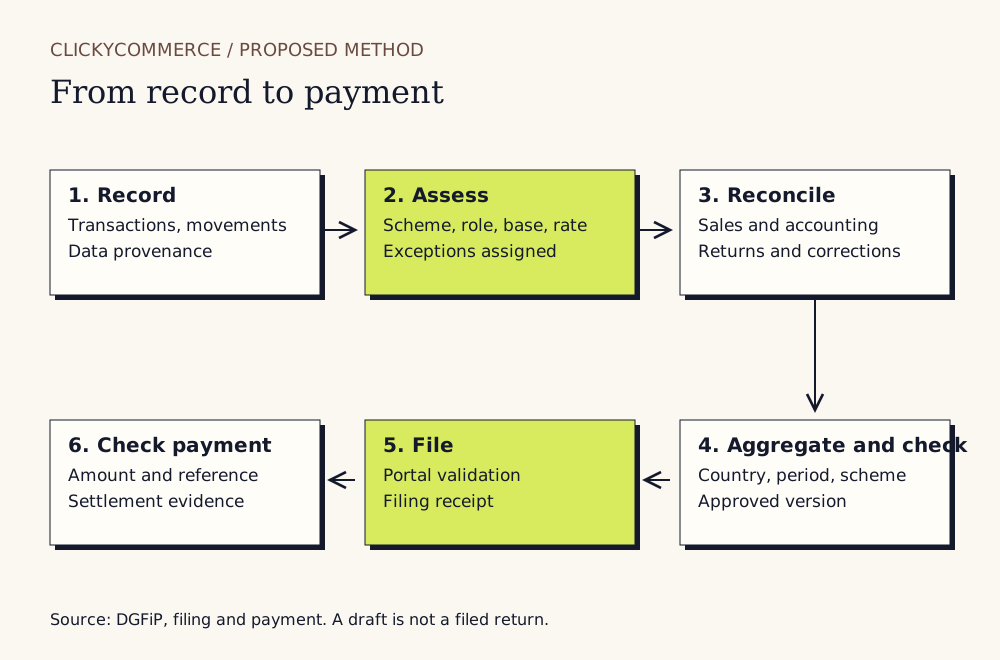
Proposed procedure: an unresolved discrepancy stays visible and needs assessment before the relevant return is validated.
Calculate complete costs without predicting gains
Compare options with identical entities, stock countries, flows, periods, transaction counts and export quality. Internal work, accounting support and software do not necessarily cover the same tasks. Subscription price does not say who assesses products, handles exceptions or represents the business before an authority. Obtain responsibilities and exclusions before comparing amounts.
No provider price is described as current here: no specific contract was examined for the reader’s business. Document initial analysis, any registrations, setup, migration, returns, corrections, support and exit. Add internal time with explicit assumptions. VAT remitted is a tax flow, separate from administrative processing costs.
Compare costs over one year
The local calculator uses this fictional annual comparison. Manual preparation takes ten hours per quarter plus six annual review hours: forty-six hours. At an assumed internal €40 hourly cost, that is €1,840. An alternative takes three hours per quarter, eight setup hours and an assumed €80 monthly subscription: €800 of time plus €960 subscription, totalling €1,760.
The calculated difference is €80 under these assumptions, before external fees and omitted costs. It does not establish a software economic benefit. More migration work or continued manual checks changes the result. Replace assumptions with observed work and actual quotes. Also verify equal country and obligation coverage.
Read cash flow separately. Remittance timing, corrections or input VAT recovery can shift cash without changing processing economics. Finance tracks expected amounts and dates with unresolved uncertainties. Bank balances after marketplace payouts do not show VAT already owed. Avoid treating every receipt as available expansion funding.
Pricing also needs explicit analysis. Holding the VAT-inclusive price constant across countries with different rates can change revenue excluding tax. In a fictional €120 VAT-inclusive example, an assumed 20% rate gives €100 excluding VAT; an assumed 25% gives €96. The €4 difference is not a margin forecast: include other revenue and costs.
The order contribution-margin guide, in French extends calculation to acquisition, logistics and returns. Keep units and distinguish revenue excluding VAT, VAT itself and costs. A foreign warehouse’s quoted shipping saving does not prove better contribution if compliance costs, complexity and returns are omitted. The choice may be favourable, but needs the full scope.
| Processing option | Responsibilities to specify | Costs to obtain | Selection condition |
|---|---|---|---|
| Controlled internal preparation | Assessment, exports, filing, payment | Time and cover checks | Understandable flows and available expertise |
| Software with internal checks | Configuration, errors, exceptions | Subscription, integration, maintenance | Reliable data and verified coverage |
| Specialist provider | National and scheme scope | Fees, corrections, support | Clear contract and transmission evidence |
| Mixed organisation | Boundaries between participants | All items without duplication | Defined reconciliation and closing ownership |
Prepare for ViDA without applying future rules early
ViDA was adopted on 11 March 2025, according to the European Commission’s updated timetable. The page separates entry into force, clarifications applicable from 1 January 2027 and single-registration elements from 1 July 2028. Adoption and application differ. An announced simplification does not remove today’s obligations for current transactions.
Reasonable preparation means retaining reusable data and following dates affecting the business model. A future own-goods transfer module does not make current mapping unnecessary. Mapping will identify which transactions might change reporting routes. Check available functions and national measures at migration time: a European timetable does not prove an operational button exists in the French portal.
French electronic invoicing and e-reporting have their own scope and do not automatically replace OSS. The French electronic-invoicing guide, in French treats that work separately. Some data can be reused, while purposes, populations and filing evidence remain distinct. One order export does not imply one return valid for every administration.
Actions and reasons to wait
First map both contractually permitted and observed flows. Operations identifies warehouses, returns and possible reallocations; finance identifies schemes and obligations needing assessment. The deliverable is a matrix by entity and flow type. Unknown cells have an owner and expected evidence. This prevents configuring a tool too early and hiding differences.
Second, test data. Technology and finance reconstruct operations covering each branch from available evidence, checking uniqueness, dispatch, rates, refunds and reconciliation. Success means a reproducible calculation assigned to a validated regime, not merely an error-free import. A flow missing from exports blocks conclusions depending on it.
Third, organise the filing cycle and cover for absences. Name preparation, review, filing, payment and reconciliation owners, including what happens after error or absence. A microbusiness can outsource some tasks but needs to know data to supply and proof to recover. SMEs particularly need stable interfaces. Larger businesses must maintain separation between companies and retain local responsibilities in consolidated files.
Waiting before activating foreign stock can be sensible if local obligations remain unassessed or movements cannot be exported. Continuing a proven fulfilment model can buy preparation time. Measure any logistics cost; the choice remains reversible. Waiting concerns a new flow, not avoiding corrections to obligations already applying to existing sales.
Keeping existing tools can be reasonable where operations are few, documented and actually reconciled. This guide does not present software purchase as a general requirement. Conversely, a manual process is difficult to justify if exceptions accumulate untreated or nobody can reproduce calculations. Decide from observed errors and dependencies, with a defined review trigger.
Self-assessment
Answer yes with evidence, no, unknown, or not applicable with a documented reason. Non-applicability needs a specific basis and does not validate an obligation without examination. No personal information is requested or transmitted. The result directs checks, not a tax-compliance score.
- Have selling entities and establishments been identified?
- Is actual dispatch country available for every flow?
- Are destinations and customer statuses assessed with evidence?
- Are the €10,000 conditions and aggregate checked over both years?
- Are foreign-stock movements and domestic sales handled separately?
- Are marketplace roles documented by transaction type?
- Are bases and rates validated for product, country and date?
- Do returns and credit notes remain linked to original sale and period?
- Are OSS returns reconciled to sales and accounting?
- Are filing, payment and retention evidenced separately?
If early answers expose unknown entities, dispatch origins or destinations, begin with mapping and assessment. Later totals cannot compensate for a wrongly defined population. If mapping exists but the threshold or platform role is unresolved, validate those branches before configuring reporting. The evidence needed is a reasoned decision about the relevant flows.
If schemes are assessed but rates, returns or reconciliation are missing, prioritise data quality and closing. A tool can help where coverage is demonstrated, but does not replace source evidence. If every answer is supported, maintain checks and prepare review triggers: new stock, entity, product, tax option, platform change or applicable legislation.
Closing checklist
- Entity, period, scheme and sources frozen.
- Flows and exceptions assessed; dispatch and destination checked.
- Bases and rates recalculated; duplicates and differences explained.
- Returns and corrections linked to periods and countries.
- Aggregates reconciled to sales and accounting.
- Filing validated and payment checked separately.
- Receipts, records and method retained in usable form.
Each checkbox links to evidence for the exact closing concerned. An inapplicable step has a reason; missing data remains a visible exception. Another person can then reconstruct why a country or amount was excluded. The desired quality is a reproducible decision, not a fully filled-looking spreadsheet.
Sources and limits
Primary sources reviewed on 9 November 2026: Commission OSS explanation, DGFiP registration, in French, DGFiP filing and payment, in French, official French OSS guide, March 2021, cross-border SME scheme and ViDA timetable. The older guide supports corroborated mechanisms and explicitly situated examples, not anticipation of future changes. Real rates, national obligations, special territories, contracts and transactions still need assessment. No tax account was opened, configured or used for this guide.
Additional checks on 10 November 2026: VAT Directive, Articles 17 and 21, Regulation 282/2011, Article 61, BOFiP recapitulative statement, paragraph 95, and official French domestic exemption page. Case rates and amounts are calculation exercises, not a national tax-rate table. French sources are identified as such; translation does not extend French domestic rules to other countries.
LOCAL TOOL / NO TRANSMISSION
Your next check
Answer ten questions. Each not-applicable answer needs a reason to review. No compliance score. Answers are processed in this page; the tool neither saves nor transmits them.
EXPLICIT MODEL
Calculate using your assumptions
Educational annual comparison over four quarters. Equal coverage needs checking. Excludes professional and other fees.
This calculation measures neither ROI, conversion improvement nor complete regulatory costs.
Evidence
Primary sources
- The One Stop Shop
European Commission, TAXUD · accessed
- Registering for the VAT One Stop Shop (French)
DGFiP · accessed
- Official VAT One Stop Shop guide (French)
European Commission · accessed
- Cross-border SME scheme
European Commission · accessed
- Filing and paying (French)
DGFiP · accessed
- VAT in the Digital Age
European Commission, TAXUD · accessed
- Implementing Regulation (EU) 282/2011, Article 61
European Union, EUR-Lex · accessed
- Directive 2006/112/EC, Articles 17 and 21
European Union, EUR-Lex · accessed
- BOI-TVA-DECLA-20-20-40 (French)
DGFiP BOFiP · accessed
- French domestic small-business VAT exemption
Service Public Entreprendre · accessed
- Intra-Community trade formalities (French)
Service Public Entreprendre · accessed
- Using the VAT One Stop Shop in France
DGFiP · accessed