

Decision summary
Confirmed
What changes
- GPSR scope and sector-specific obligations must be assessed for each product and provision.
- Distance sales offers must display the applicable information in the four groups in Article 19.
Recommendation
What you can do
- Reconcile a receipt, its identifiers and the relevant document versions.
- Check the selected variant, French information and actual offer display.
- Run a reverse search from a manufacturer's identifier.
To establish
What remains unknown
- This guide does not audit any real business's suppliers, products or systems.
- The example retains two returns whose identifiers remain unknown.
To make product traceability reliable, start with a received unit. Can you find its manufacturer, identifier, matching documents and the offers selling it? Establish the product’s regulatory position and your role, record each receipt without overwriting earlier ones, then search backwards from a manufacturer’s identifier. If that search fails, repair the relationship before buying software. The GPSR sets certain safety and information obligations; the record helps implement them within a defined scope.
This guide is for shops, brands, importers, distributors and marketplaces operating on the French market. It proposes a method for receiving goods, checking catalogue information and finding units potentially affected by an alert. A microbusiness can use a documented register; an SME can connect its systems; a group particularly needs clear responsibilities between legal entities. The organisational recommendations below are operational choices, distinct from the cited legal obligations.
The General Product Safety Regulation, or GPSR, has applied since 13 December 2024. Assess its scope and relationship with sector legislation before treating Articles 9 to 18 as a checklist. The consolidated Regulation 2023/988, particularly Articles 2, 19 and 51, is the central source for this analysis, reviewed on 9 November 2026 with additional checks on 10 November. This English edition keeps the original’s focus on businesses operating in France.
Contents
- Establish the scope before adding fields
- Assign roles to each operation
- Build product identity without invented identifiers
- Check the receipt and the offer customers actually see
- Organise evidence and retention
- Choose tools around observed breaks
- Test the chain without initiating a recall
- Handle returns and changes without losing the relationship
- Track relationships still missing
- Priorities and reasons to wait
- Self-assessment
- Checklist before making a product available
- Sources and limits
Establish the scope before adding fields
The GPSR is not a single regime that applies identically to every category of goods. Article 2 excludes, among other things, food, feed, medicines and antiques. For products subject to specific EU safety requirements, it determines the relationship according to the aspects and risks already covered. Certain parts, including Chapter III, Section 1, do not apply to products subject to Union harmonisation legislation. That distinction matters when identifying operators’ obligations.
A retailer selling toys, small appliances and decorative articles cannot reuse the same document checklist without examining the rules for each category. Assessment may need to reach individual products where their use, characteristics or presentation change the applicable regime. Appearance alone is insufficient: an item presented for children may need a different assessment from a decorative object. Use expertise appropriate to the category.
The first question in the register is therefore not whether you have a GPSR certificate. It is which product is actually sold, for what use, in which countries and under which rules. The Regulation establishes safety, documentation and cooperation requirements; it does not create a universal commercial certificate that settles every check. Read a document labelled compliance for its actual coverage, issuer, version and exclusions.
The DGCCRF explains the main product safety changes. For dates and detailed obligations, this guide refers to the Regulation itself. Suggested data entry, search and work allocation practices are proposed methods, not mandatory administrative formats.
Check territory too. Article 4 treats distance sales offers targeting EU consumers as making products available on the market. Hosting a site outside the Union does not automatically put it outside the rules. Conversely, accessibility from France does not replace an assessment of targeting. Record languages, delivery destinations and commercial arrangements without treating any one indicator as decisive by itself.
Give the transitional provision its own record. Article 51 concerns products complying with the previous Directive and placed on the market before 13 December 2024. It does not say that all stock bought before that date escapes the new requirements. An order date, catalogue year or old SKU may not prove when the product was first placed on the market. Keep the assessment and supporting documents so that the transition is not incorrectly extended to recent replenishments.
If a business already has a compliance inventory, review its boundaries: excluded categories, sector-specific regimes and products needing further assessment. The European e-commerce compliance guide, in French gives the wider picture. This guide addresses a narrower need: establishing and testing relationships between product, documentation, offer, stock and order.
A toy retains its own rules
Take a toy. Being subject to Union harmonisation legislation does not remove every GPSR provision. Article 2(1) distinguishes risks already covered and excludes certain provisions, including Chapter III, Section 1, for products subject to that legislation. Look for manufacturers’, importers’ and distributors’ obligations in the relevant sector text. Article 19 still needs examination for distance sales; point (d) expressly refers to safety information required by harmonisation legislation. Labelling an Article 9 checklist mandatory for every toy would erase this distinction.
For the catchall tray in the example, the assessment records its stated use, examined characteristics, applicable texts and reasons for excluding other considered regimes. If marketing changes to target children, purchasing must not simply reuse the earlier conclusion. Send the new presentation to the competent function to reassess the product and required documents. That is a concrete review trigger even if the SKU is unchanged.
Assign roles to each operation
Obligations follow neither business size nor the word shop. The Regulation defines manufacturer, importer, distributor, authorised representative and fulfilment service provider, among others. A business can hold different roles for different ranges. Record the role for the chain concerned and the relevant legal entity. A shared sales team does not make several companies’ responsibilities interchangeable.
Under Article 13, a person placing a product on the market under their name or trademark is considered its manufacturer for this Regulation. A brand outsourcing production cannot conclude that it is only a distributor because it owns no factory. The same Article covers certain substantial modifications affecting safety. The person entering product page data should not improvise that assessment.
Where Chapter III, Section 1 applies, Article 9 sets out manufacturers’ requirements concerning risk analysis, technical documentation and identification. Importers and distributors have their own obligations under Articles 11 and 12. Asking all suppliers for the same document may simplify collection, but does not change legal responsibilities. Explain why each document is needed and who must be able to provide it.
Read Article 16 on the responsible person established in the Union alongside its reference to Regulation 2019/1020. Do not automatically equate that role with the parcel carrier or a commercial address purchased to complete a form. The name, role and scope must match a real arrangement. Where the manufacturer is outside the Union, Article 19 also requires certain information about this responsible person in the distance sales offer.
A marketplace must separate its interface-provider role from any sales it makes itself. Article 22 sets specific obligations, while sellers retain those arising from their activities. The marketplace operational requirements guide, in French covers the general framework. Here, an offer must connect to the seller, product and version of the information received. Listing on a major platform does not establish product safety.
| Situation to assess | Responsibility to identify | Useful document or check | Conclusion to avoid |
|---|---|---|---|
| Product bearing the retailer’s brand | Manufacturer role under Article 13 | Brand assessment and applicable file | The subcontractor manufactures it, so we are not the manufacturer |
| Purchase from a third country | Actual importer and other operators | Supply chain and placing on the market | The carrier is automatically responsible |
| Resale of a product already supplied in the Union | Distributor role to assess | Supplier, identification and applicable checks | An invoice proves all compliance |
| Offer hosted by a marketplace | Seller and interface provider | Transmitted data, display and alert process | The platform handles all our obligations |
Build product identity without invented identifiers
A SKU is a management identifier chosen by the business. It can represent a commercial variant without distinguishing successive deliveries. A type, batch or serial number serves other purposes. Within its scope, Article 9(5) provides for a type, batch or serial number, or another identification element. It does not require every product to have all those categories simultaneously.
Record the kind of identifier before its value. A column called product number quickly becomes ambiguous if it variously holds an internal SKU, supplier code or individual serial number. Add type, source and a link to the relevant object. If information is missing, use an explicit to-obtain state. Inventing a batch to pass a software import makes later searches less reliable.
Separate documentary references from physical identifiers. Instructions may cover several models; a report may concern a particular version; a photograph may show older packaging. Explain which document applies to which product version. Similar names alone establish a hypothesis, which should remain visible until an appropriate source or competent check confirms it.
The worked example concerns a non-electrical wooden catchall tray sold under the fictional SKU VP-SABLE. It is assumed to be for adults, with no food-contact use or toy function, and within GPSR scope for the obligations examined. These assumptions matter: presenting it as a toy would require a different assessment. All document names and identifiers in the example are fictional. The register contains no real customer or actual business inspection result.
Relationships must work in both directions. Starting from the product page, find document versions and possible receipts. Starting from a supplier identifier, find related SKUs, channels and stock. The reverse direction exposes links a completeness check misses, such as differently named variants from the same production. Keeping the query makes the search reproducible.
The proposed register connects five objects: commercial product, manufacturer identity, physical receipt, channel offer and logistics movement. Documents remain linked to the objects they cover. A spreadsheet or database may suit, depending on volume and collaboration. No particular technology is required initially; each relationship needs an explainable meaning and a way to correct it without erasing useful history.
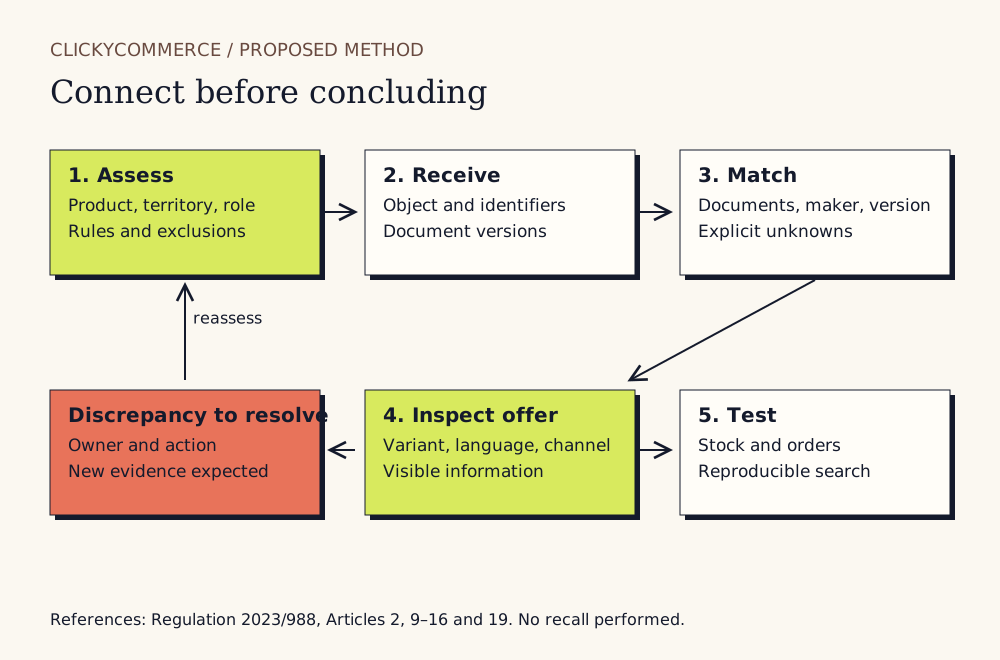
Proposed procedure: uncertain information goes back for assessment; automation does not turn it into evidence.
Two receipts under one SKU
The completed traceability record uses exactly the twenty columns in the blank template. It contains three checks: receipt A, receipt B with a discrepancy, and the review closing that discrepancy. Document references identify evidence a business would need in its own system; they do not claim any real photograph or inspection exists. The accompanying teaching notes describe what each observation should show.
In the scenario, REC-A on 2 October brings sixty units identified by the manufacturer as batch A-061 and type VP-01. REC-B on 20 October brings forty units under the same SKU, but type VP-02 and batch B-104. Instructions for the first receipt are DOC-VP-V1. The second arrives initially with that earlier document, whose model does not match the observed type. The discrepancy is a failed relationship, not merely an empty cell.
| Fictional check | Observation | Assigned action | Scenario result |
|---|---|---|---|
| TR-A | REC-A, type VP-01, batch A-061, DOC-VP-V1 | Product lead: match object and document | Relationship documented for the intended sample |
| TR-B | REC-B, type VP-02, batch B-104, old V1 document | Purchasing: obtain coverage for VP-02 | Document match pending; receipt held in a location requiring clarification under the example procedure |
| TR-B-REV | DOC-VP-V2 received in the scenario | Product lead: check model and version; catalogue: review offer | Relationship explained and demonstration offer reviewed; earlier relationship retained |
Purchasing requests a document explicitly covering VP-02 rather than one simply mentioning GPSR. When DOC-VP-V2 arrives in the scenario, the product lead checks the model, issuer and version, then records the conclusion. Catalogue staff check that the sand-colour variant uses that type’s information. TR-B stays in history with its initial discrepancy; TR-B-REV records what changed and the observation needed for closure.
Physical checks must keep their actual scope. If receipt inspection covers three units from a carton, the evidence describes those three and the sampling rationale. It does not turn forty units into individually inspected objects. A discrepancy in a sample requires a decision appropriate to risk and procedure, not an automatic rule invented here. Replace the example quantities and method with those assessed for the actual range.
Reviewing the offer also means handling older stock. If VP-01 and VP-02 cannot accurately share the same information, consider separating variants or suspending the combination producing inaccurate information until corrected. The choice depends on the product and actual sales operation. Do not retrospectively rename the first sixty units to resemble the newer delivery.
Check the receipt and the offer customers actually see
First check the received object. Compare references on the product, packaging and accompanying documents. Article 9 provides alternatives for placing certain information where the product’s size or nature prevents it appearing on the object. Absence from one location therefore needs assessment against the applicable arrangements. Receiving staff should know when to record a discrepancy and who should receive it.
A photograph supports reconciliation if it shows readable information and the product it belongs to. A generic supplier picture does not prove the labelling on the received delivery. Link the check date, receipt, observed identifier and information location. For a sample, describe both the units examined and those not examined.
Document review asks whether the file explains the chosen assessment and applicable requirements. Where Article 9 applies, a commercial declaration alone does not replace the prescribed analysis and documentation. A distributor should not be told to create every manufacturer document itself, but must perform checks falling within its role and be able to escalate necessary information.
The four Article 19 information groups
For distance offers within scope, Article 19 of Regulation 2023/988 requires four groups of information to be clearly and visibly presented. Point (a) covers the manufacturer’s name, registered trade name or trademark and postal and electronic contact addresses. If the manufacturer is outside the Union, point (b) adds the name and postal and electronic addresses of the responsible person under Article 16 or Article 4 of Regulation 2019/1020. Point (c) identifies the product through its picture, type and any other product identifier. Point (d) covers warnings or safety information required with the product by the Regulation or applicable harmonisation legislation.
| Offer information | Check for VP-SABLE | Fictional evidence and decision |
|---|---|---|
| Manufacturer | Identity and both contact addresses | Compare label and DOC-VP-V2; demonstration contact details remain within the case system, with no invented address published here |
| Responsible person in the Union | Example manufacturer assumed established in the Union | Point (b) condition not triggered; record why rather than invent another person |
| Product | Sand-variant image, type VP-02 and relevant identifier | Check after selecting the variant; SKU alone does not document every relationship |
| Safety | Information required by applicable texts | Check the assessed French wording and version; no fictional statutory warning is supplied |
This table describes checks, not a ready-to-sell listing populated with fictional people. Obtain real contact details from verified documents. Article 19 does not require a live display of every stocked batch before every purchase here. However, the catalogue’s type and other identifiers must accurately describe the offered product. A promise of unit-level matching requires tracking that actually supports it.
An offer understandable in France
Article 19(d) concerns a language easily understood by consumers, as determined by the Member State where the product is made available. In France, Article 2 of the Law of 4 August 1994 requires French notably for designation, offers, presentation and operating or usage instructions. Check French offer content and applicable safety information, including versions. When translating, review terms that change an instruction’s meaning. A language button alone does not verify the content.
Test the selected variant: a page may combine products with different characteristics. A shared image, instruction or warning may become inaccurate after an option is chosen. Compare initial and selected states. The product image guide, in French examines visual correspondence; traceability adds the connection to documents and the actual received object.
Mobile checks should be practical. Correctly stored information can disappear behind a panel that will not open, a clipped component or a language change. Check keyboard access, expanded content and readability at the tested width. A screenshot records an observed state, but does not replace the interactions needed to reach it. Name the URL, variant, language and date in the review.
For marketplaces, distinguish transmitted data from displayed information. An accepted feed or successful synchronisation proves a technical step, not necessarily that contact details or warnings appear in the live offer. The channel owner records the transmitted version and inspects the accessible presentation. Where the platform transforms fields, retain mappings and assess information lost or replaced.
A provider may offer a responsible-person field without checking the legal basis for that role. Checking its length or address format is insufficient. Connect the person to the product and applicable arrangement. Someone fixing display problems must not invent an identity to pass technical validation. Legal and technical discrepancies need separate decisions.
| Check | Input to compare | Output evidence | Limit to retain |
|---|---|---|---|
| Receipt | Object and observed identifiers | Dated record and readable document | Sampling and unseen units |
| Documentation | Product, version and regime | Explained document relationships | Assessment still uncertain |
| Site offer | Variant, language, contacts, warnings | Tested display and interactions | Untested states |
| Marketplace | Transmitted feed and visible offer | Field mapping | Platform delay or transformation |
| Logistics | Receipt, transfer and picking | Reproducible search | Mixing or lost relationships |
Organise evidence and retention
The proposed template records the check reference, product description, assessed role, relevant texts, source documents and versions, observed identifiers, inspected channels, discrepancies and assigned owner. Each closure adds the new document or review result. The downloadable template is an organisational tool, not a statutory form prescribed in this format.
Retention periods belong to specific categories
Within the relevant provisions’ scope, retention depends on what must be producible. Article 15(3) and (5) concern economic partners in the chain; they do not impose indiscriminate retention of every consumer’s data for six years. Keep the starting event alongside the period. Archiving solely by file creation date can delete information too early or retain it without justification.
| Category | GPSR provision | Period and starting event |
|---|---|---|
| Manufacturer’s technical documentation | Article 9(3) | Ten years after the product is placed on the market |
| Risk, complaint and corrective-measure information covered by cooperation | Article 15(2) and (4) | Ten years after the operator received or supplied the product, as applicable |
| Identity of supplying operators and professional recipients concerned | Article 15(3) and (5) | Six years after receipt or supply by the operator, as applicable |
| Personal data in the manufacturer’s complaints register | Article 9(13) | Only as necessary for investigation, at most five years after entry |
These categories need separate archiving rules. The register may link to a document rather than duplicate it, provided authorised people can still open it. Assess other data categories for their own purposes. The generic label GPSR file does not determine a lawful retention period.
The manufacturer’s complaints register illustrates the distinction. Article 9(13) restricts personal data to what investigation needs and retention to the necessary duration, with a maximum of five years after entry. Retention policies must therefore distinguish categories and purposes. Keeping all customer exports for ten years in the name of GPSR would be an excessively broad conclusion.
Access should follow need. Someone checking instructions does not necessarily need all customers’ contact details. A logistics provider needs identifiers and instructions relevant to its operation. A shared preparation file can use pseudonymous references and quantities, leaving named data in the proper system. Restricting access avoids unnecessary copies while allowing preparation.
History must survive supplier and software changes. Before catalogue migration, export relationships and verify import with a sample representing complex situations. Backed-up files do not prove that links to the correct products survive. Test a current product, an older version and a withdrawn product. Otherwise, lost relationships may only become apparent during an alert.
Choose tools around observed breaks
A spreadsheet may suit a small range and few users if versions and documents remain understandable. Its apparent software cost is low; checking costs depend on manual handling and confusion risks. Test reverse search and restoration before making it the central register. A batch column does not prove physical units are distinguished.
A PIM chiefly organises product information and distribution. Depending on actual features, it may hold contacts, warnings and document links. It does not necessarily replace batch tracking during picking. A WMS may record logistics movements without assessing catalogue legal information. Choose around observed breaks between these systems, then verify features, exports and contractual limits.
Integration helps when it transfers relationships and their states rather than text alone. A manufacturer change should trigger review of affected offers under a defined rule; a new receipt should flag an identifier difference. These are design recommendations. Test errors, retries and duplicates: a successful normal synchronisation does not prove a reliable chain after interruption.
PIM, WMS and responsible-person service prices depend on functions and contracts; no universal price is documented here. Request quotes specifying references, users, channels, storage, API, support, exports and exit arrangements. Include migration and checking time in total cost. A lower subscription can cost more if it requires manual maintenance across channels.
Setup budget
The local calculator uses an explicitly educational model. For one hundred new references, assume twenty minutes of collection and reconciliation each, eight setup hours and five review hours. Initial work totals 46 hours and 20 minutes. At a hypothetical internal cost of €35 per hour, that is approximately €1,621.67, excluding software, specialised testing and external fees. These assumptions are neither market prices nor a complete compliance cost.
The model makes omitted items visible. Add observed rework if documents arrive in several versions. Budget language review separately for additional countries. Request specialist testing quotes for categories needing it rather than applying catalogue staff costs. Keep the final budget as documented items, explicit unknowns and owners responsible for resolving them.
| Option | Useful when | Costs to document | Exit criterion |
|---|---|---|---|
| Controlled register with linked documents | Limited range, simple collaboration | Updates, backup and search time | Readable export and tested restoration |
| PIM with distribution | Many attributes and channels | Migration, rules, connectors, display review | Exportable relationships and documents |
| WMS with physical identifiers | Complex receipts and picking | Hardware, setup, training, discrepancies | History usable outside the provider |
| Integrated arrangement | Established breaks between systems | Integration, supervision, retries, support | Reproducible search exercise |
Test the chain without initiating a recall
An internal exercise should be explicitly fictional and stay outside public alert portals. Select a reference and find related documents, offers and stock. Then add an older version or supplier identifier shared by multiple SKUs. The objective is to establish what the systems can identify. No customer message, public withdrawal or fictional regulatory report is needed to test documentary capability.
Define more than find all products. Specify the starting relationship, storage locations and channels examined. A result can be accurate for the main warehouse and unknown for units with a provider. Keep that distinction. An unobtained quantity remains unmeasured, not absent stock. The next decision is how to obtain the data or cautiously broaden the investigation.
Separate located units, units with an established relationship and potentially affected units without a certain match. Record queries and exports. If the batch is recorded on receipt but lost at picking, the system may find inbound goods without identifying orders. State that explicitly. A customer list based only on SKU may be too broad or too narrow.
A public example shows why checks cannot stop at the first listing removal. In its Safety Gate 2025 report published on 5 March 2026, the Commission describes withdrawals, recalls and listing removals, and use of a surveillance tool for products already reported and offered online. This documents enforcement activity, not the probability of danger in an individual merchant’s catalogue.
A real alert follows a different process. Articles 9, 11 and 12 provide for measures according to role and circumstances, notably for dangerous products. Article 20 addresses accident notification without undue delay under its stated conditions. An internally chosen customer-service deadline cannot replace these rules. Responsible people must assess the case and act under applicable provisions without waiting for the documentary inventory to be complete.
The alert and recall chain guide, in French examines that next stage. Offer withdrawal, stock blocking, authority notification, consumer communication and remedies are distinct actions. Prepared traceability supports them but does not prove they occurred. A submitted report does not prove every recipient received information; a sent email does not prove a remedy was delivered.
Reverse search with quantities and limits
The fictional movement extract extends the case. REC-A’s sixty units split into thirty-eight shipped with links retained and twenty-two still located. REC-B’s forty units comprise ten shipments linked to B-104, twenty-eight located units and two returns whose identifiers can no longer be confirmed. The equations 38 + 22 = 60 and 10 + 28 + 2 = 40 check consistency without removing uncertainty about the returns.
Start with B-104. Logistics filters receipts, follows movements attached to REC-B and extracts anonymous references for the ten known shipments. It can attribute twenty-eight located units and ten shipments to the batch. The two returns are a separate population: their origin is assumed in the exercise, but the available record cannot confirm their identifier. They remain pending clarification, neither added to the twenty-eight identified units nor removed from the physical total.
If picking had recorded only VP-SABLE, all forty-eight shipments from both receipts would form a possible population to examine, not forty-eight demonstrated B-104 orders. Explain this lost precision in the report. The distinction determines the next investigation’s scope. A total of one hundred units supports counting; preserved relationships support targeting units and shipments at the stated certainty level.
Close the exercise with the query, register version, recovered quantities, two unresolved returns and owner of the next step. Do not promise a universal completion time in hours: the relevant time depends on circumstances and applicable requirements. In actual danger, documentary preparation supports alerts and required measures; it must not delay them while staff perfect a spreadsheet.
Handle returns and changes without losing the relationship
A returned product is more than a positive stock adjustment. Packaging may have changed, labels may be unreadable or accessories different. Before reintegrating a unit into sellable storage, the proposed returns procedure checks whether the necessary identity remains known. That is a logistics recommendation. Resale also needs an assessment of product condition and applicable rules, independently of its identifier.
Shared returns between channels increase the problem. A site reference may return to a centre using only a marketplace code. The mapping must explain the transition between identifiers and retain uncertainty where multiple versions remain possible. Automatically selecting the first similar reference creates false precision. Use a clarification process with someone authorised to decide the destination instead.
In VP-SABLE, the two unidentified returns stay separate from stock of known type. The owner looks for shipment references and readable information; if the relationship remains undecidable, they arrange an assessment of the units’ destination. The register permits a reasoned decision not to reintegrate. Assigning B-104 merely because it resembles the latest delivery would mislead subsequent searches.
Repairs and refurbishment also need assessment specific to the operation. Work may change a component, software version or possible use. Article 13 defines criteria for substantial modifications affecting safety; not every repair automatically meets them. Keep the intervention and scope so competent people can assess consequences instead of letting a commercial status change decide.
Kits add another relationship. Where a commercial set includes several components, determine what identification level can retrieve the component named in an alert. The kit code can stay unchanged when a component changes. A useful test starts from the component, finds possible kits, then affected offers and picking operations. No invented uniform serialisation requirement is needed to recognise lost necessary information.
Prepare for losing access to a provider. Ask what export is available at contract end or during an interface outage. Test an actual export opened outside the system and reviewed with operations. If document links point only to temporary addresses, arrange authorised retention of required files. Reversibility means being able to repeat the search, not merely having a contractual promise of an export.
Track relationships still missing
Search time can be measured in an announced exercise, but interpretation depends on the starting point. Finding a page from a known SKU differs from starting with an old manufacturer identifier. Specify the request, available systems, manual interventions and missing results. The aim is comparability for the team. Observed time becomes neither a general regulatory requirement nor a guarantee during a real alert.
Closed discrepancies alone are also insufficient. Document closure and display correction may address the same issue; counting them as two secured products exaggerates progress. Follow each discrepancy to final evidence and flag reopened cases. A provider or version change may reopen an earlier checked relationship without making the original work useless. It shows the evidence covered a particular state.
Periodic review can select demanding situations: older product, changed receipt, incomplete return, external channel and reverse search. No universal sample percentage is proposed. Choose coverage around activity and assessed risk, recording the reasons. The result should clarify system capabilities and gaps enough to decide where to act next.
Priorities and reasons to wait
Start with a product family whose role and regime are sufficiently assessed to test the process. The product lead formalises the assessment; purchasing gathers documents; logistics records identifiers; catalogue staff inspect the offer. The expected result is a reproducible check file with discrepancies and dependencies. Timing depends on available evidence; a uniform number of days would hide the obstacles.
Next close breaks preventing decisions. Uncertain manufacturer identity, missing safety information and inability to locate units have different causes. Give each discrepancy an owner, action and expected proof. Internal deadlines must reflect risk and applicable obligations; they do not permit continued sales that authorised people should suspend.
Extend to other families while retaining their differences. A microbusiness prioritises essential relationships and documented cover for absences. An SME can stabilise interfaces before raising volume. A group must check company and country boundaries. Platforms add seller-data and alert processes. Expansion follows evidence that the method works in the preceding situations.
Waiting before changing software can be reasonable where relationships exist and unclear rules cause the discrepancies. Migration cannot remove uncertainty about a manufacturer. Waiting before adding a public field may also be reasonable if its meaning is unsettled and the applicable decision permits waiting. A danger or unmet obligation must not be relabelled future optimisation.
Leaving a product page unchanged can be justified where required information is already clear and matches the product. Record that finding and review triggers: new receipt, operator, variant, channel or rule. Follow-up means reviewing pages whose facts changed, not periodically editing every page to make it look recent.
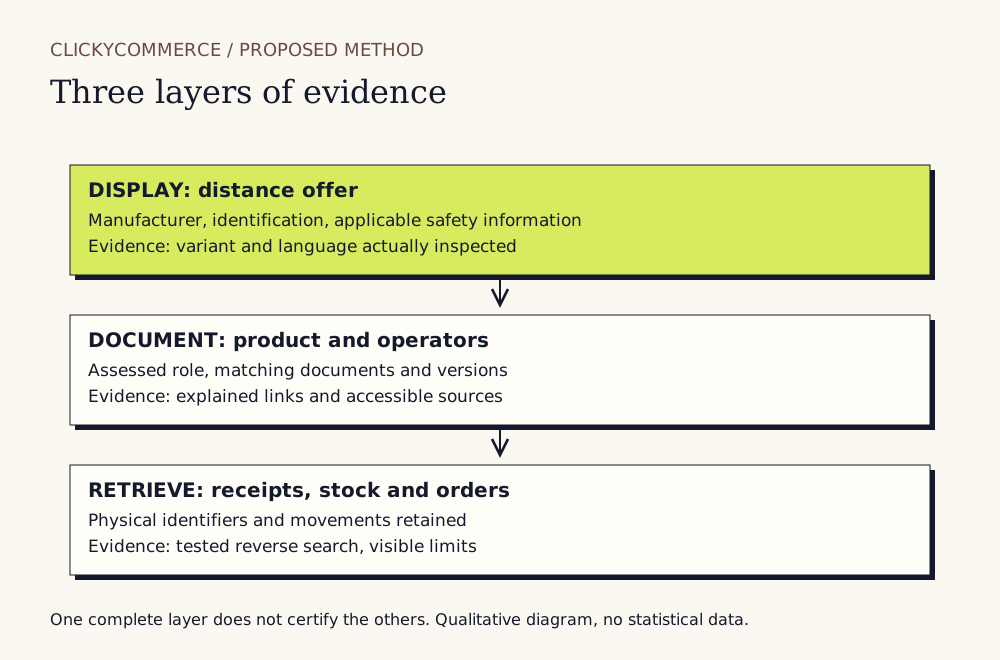
Three complementary layers, three distinct proofs: display, document and retrieve.
Self-assessment
Answer yes with evidence, no, unknown, or not applicable with a documented reason. Non-applicability requires a specific basis; it does not validate an obligation without examination. The questionnaire produces no compliance score and collects no personal data. Answers identify the next check, not product certification.
- Have the product rules and exclusions been assessed?
- Is the business’s role established for this supply chain?
- Is the manufacturer connected to the received product through usable evidence?
- Are physical identifiers distinguished from commercial SKUs?
- Has the responsible person in the Union been assessed where relevant?
- Does the visible offer contain applicable Article 19 information?
- Were variants and languages checked in the actual display?
- Can receipts, transfers and orders be reconciled?
- Do documentary discrepancies have an owner and closure evidence?
- Has an internal search exercise been run without publishing an alert?
If either first answer is no or unknown, start with the competent function’s assessment. Later answers cannot compensate. A complete-looking file may address the wrong regime or a role the business does not hold. Obtain a reasoned assessment, then reread the relevant requirements. The outcome is an understandable decision rather than a reassuring percentage.
If the assessment exists but identity or offer information answers are negative, open a targeted discrepancy for that product and channel. Obtain the missing evidence, check its match and arrange a decision on required measures. Where public information is correct but movements cannot be retrieved, resolve the logistics break. Catalogue correction alone will not solve it.
Checklist before making a product available
- Product, territory and role assessment available.
- Identifiers and documents matched to the receipt concerned.
- Manufacturer and responsible person checked within their scope.
- Offer, variant, language and channel actually inspected.
- Stock and order relationships tested.
- Discrepancies, decisions and closure evidence retained.
- Alert owner and review triggers known.
Use the checklist as an entry to the detailed file. A tick must link to evidence accessible to authorised people. Where a step is inapplicable, record why instead of marking success. Someone providing cover can then understand the check without recollecting everything, and distinguish a justified exclusion from unobtained information.
Sources and limits
Primary sources reviewed on 9 November 2026: Regulation 2023/988 consolidated on 29 May 2026, DGCCRF explanations, in French, and the Commission’s Safety Gate 2025 report. The consolidated text was read in English. Sector rules, actual products, contracts and individual businesses still require assessment. No shop audit, recall or consumer contact was carried out for this guide.
Additional check on 10 November 2026: Law of 4 August 1994, Article 2, French language. VP-SABLE scenarios and document references are entirely educational. The registers and movement log describe observations to perform, not checks on real products. The English edition translates the method while retaining its French-market legal context.
LOCAL TOOL / NO TRANSMISSION
Your next check
Answer ten questions. Each not-applicable answer needs a reason to review. No compliance score. Answers are processed in this page; the tool neither saves nor transmits them.
EXPLICIT MODEL
Calculate using your assumptions
Editable educational assumptions. Excludes software, specialist testing and external fees.
This calculation measures neither ROI, conversion improvement nor complete regulatory costs.
Evidence
Primary sources
- Regulation (EU) 2023/988, consolidated version of 29 May 2026
European Union, EUR-Lex · accessed
- Product safety: changes in 2025 (French)
DGCCRF · accessed
- Safety Gate 2025 annual press release
European Commission · accessed
- Law of 4 August 1994, Article 2 (French)
Legifrance · accessed